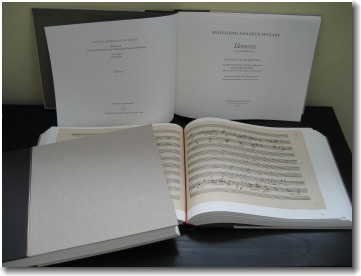
|
MOZART, Wolfgang Amadeus, 1756-1791
Idomeneo. K.366, with Ballet K.367. Facsimile of the Autograph Score
Staatsbibliothek zu Berlin—Preußischer Kulturbesitz, Biblioteka Jagiellońska
Kraków (Mus. ms. autogr. W.A. Mozart 366, 367, 489 and 490)
Introductory Essay by Hans Joachim Kreutzer. Musicological Introduction by
Bruce Alan Brown
[Mozart Operas in Facsimile, I]
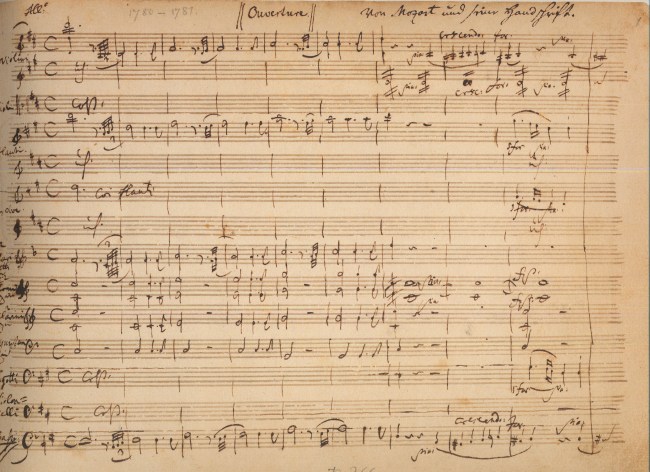 beginning of the overture
Mozart Operas in Facsimile, 1. Palo Alto, 2006. Oblong, 4°, 3 vols, 888 pp. A beautiful and exacting full-color reproduction of the autograph score composed between September of 1780 and January of 1781, with additions and corrections as late as 1786. The facsimile reunites Acts I & II preserved today in the Biblioteka Jagiellońska Kraków, and the Act III and the ballet music (K.367) held by the Staatsbibliothek zu Berlin. Mozart's score, written in a clear and neat handwriting, served as the source for a copyist's score used for the premiere, from which instrumental parts were created. Yet by no means is Mozart’s autograph score a fair copy, as it represents a fascinating mixture of completely stable portions with ones that show clear signs of fluidity and development, with numerous crossouts, multiple versions, even versions that appear as rehearsal trials. The autograph also bears witness to frequent rewrites of scene endings: cadences are cleverly adjusted and provided with transitions that enable the music to move seamlessly to the next number, a technique practically not seen again until Don Giovanni. Another feature of the opera is Mozart's use of cyclic devices, for example, composing arias based on motivic material taken from the preceding number. The nature of the commission and the relatively strict time frame imposed on the composer must have turned the Palatine Elector Carl Theodor's residence into a noisy production studio, with various rehearsals going on simultaneously, copyists preparing parts, Mozart coaching and cajoling singers, all the while he was still composing the work; as was common the arias came first (often being rejected by problematic singers), while the overture was composed last. The opera saw, in addition to its Munich performance, a concert version in Vienna in 1786 with orchestra and tenor, portions of which are also documented in the facsimile. This beautiful bibliophile edition, in three volumes, bound in dark brown quarter leather with beige linen boards, inagurates the series "Mozart Operas in Facsimiles". $215
(view
other
volumes
from this series)
ISBN 1-933280-07-7
|
|
|