| | Deluxe Color Facsimile Béla Bartók Duke Bluebeard's Castle ___________________________________ Facsimile of the Autograph Draft Manuscript Institute for Musicology Hungarian Academy of Sciences Commentary: Lászlo Vikárius Balassi Kiadó: Budapest, 2006 26 x 35 cm, 58, 51 pp. ISBN
963 506 689 9 $150 (view
other
20th-c. facsimiles)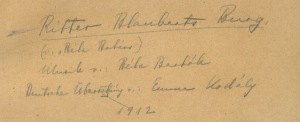 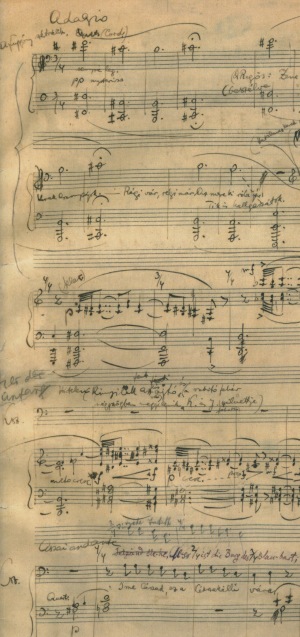 distributed by: OMI - Old Manuscripts & Incunabula PO Box 6019 FDR Station New York NY 10150 tel/fax 212/ 758-1946 http://www.omifacsimiles.com immels@earthlink.net |
| Duke Bluebeard's Castle, composed in
1911, is Béla Bartók's only opera. It is the first
large-scale example of his mature individual style, owing much to such
works as the Fourteen Bagatelles (1908), Four Dirges, Two Romanian
Dances, the Allegro Barbaro (1911), as well as the First String Quartet
(1908/9). The opera, a concise and paradigmatic work reduced to the
essentials (with just two singers), is an iconic piece in the œuvre.
Despite the somewhat suite-like character of the inner series of scenes
(or "doors"), a wonderfully closed symmetrical form prevails in the
composition that points to one of the most original formal structures
Bartók cultivated: the symmetric or palindrome form that first
made its appearance in a consistent manner in his Fourth String Quartet
in 1928. In Bluebeard Bartók created a new Hungarian style
of singing on the stage, a style based on the parlando of peasant
songs. Zoltán Kodály wrote: "this is the first work on
the Hungarian operatic stage in which the singing is consistent from
beginning to end, speaking to us in an uninterruped Hungarian
way". Almost no early sketches survive for the opera that can
unveil the origins of this new operatic manner. However, an early draft
survives—the basis of this facsimile edition—that represents the main
compositional source: it is a fascinating short score (particell) that
documents the first continuity draft of the piece, together with
indications of orchestration and many revisions and second thoughts.
This remarkable autograph—the first vocal score of Bluebeard as the
composer described it in an unpublished letter— was once in the
possession of Emma Schlesinger-Kodály after whose death it
passed to the Bartók Archives of the Hungarian Academy of
Sciences. Apart from the importance of the source for shedding light on
compositional process, it also contains the first German translation of
the libretto made by Emma Kodály (copied into the manuscript by
her husband, Zoltán Kodály), a wonderful testimony of the
close friendship of Bartók and the Kodálys, a friendship
that was decisive for the composer's intellectual and music development
for all of his life. (adapted from László
Vikárius' text)  | |