|
| The Arundel Choirbook London, Lambeth Palace Library, MS 1. A Facsimile and Introduction 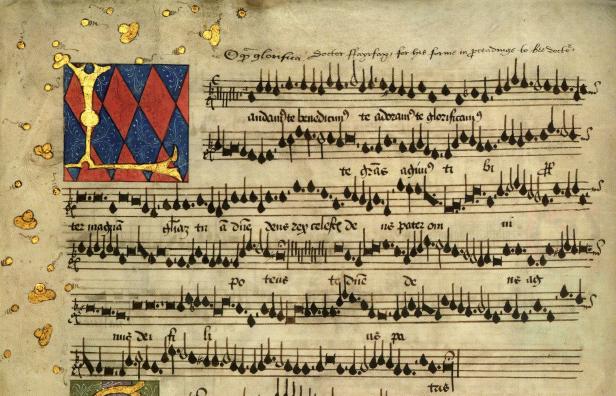 f. 8v "O quam glorifica" (detail) by Robert Fayfax (1464-1521) Three English choirbooks have survived intact from the early Tudor period: the Eton Choirbook, and the “Caius” and
Lambeth” Choirbooks (now housed at Gonville & Caius College, Cambridge, and Lambeth Palace Library, respectively). While Eton is known to have originated from the great college of that name, the provenance of Caius and Lambeth has, until now, been a complete mystery. The man responsible for their production has long been held to be Edward Higgons, a prominent Tudor lawyer and multiple plurist who was a canon of St. Stephen's, Westminster, where Nicholas Ludford, a principal composer in both manuscripts, was employed from the early 1520s. On the last page of the Caius Choirbook is written the inscription “Ex dono et opere Edwardi Higgons cuius ecclsie canonicis”, which may be translated as “By the gift and work of Edward Higgons, canon of this church”. The “ecclesia” is now believed to be St. Stephen's, although the origins of the Lambeth Choirbooks have been much less well understood. It has, however, been generally accepted that it too was produced for one of the ecclesiastical institutions with which Higgons was associated. In this Roxburghe Club volume, Dr. David Skinner (Magdalen College, Oxford) casts new light on the hitherto unknown origins of Edward Higgons, who, after a successful legal career in Shropshire and Westminster, retired in 1520 to the mastership of Arundel College in Sussex. In addition, a manuscript roll containing Ludford's music (discovered in the archives of Arundel Castle in 1982) has been found to have been copied by the person who produced Caius and Lambeth, leading to the strong presumption that both books originated from Arundel: Caius as a presentation manuscripts from Higgons, as Master of Arundel College, to St. Stephen's, Westminster, while Lambeth remained at Arundel as a “working” choirbook. A plausible line of descent for the latter book can be traced from Arundel College to Lambeth Palace Library, its final resting place. This is a story of one music manuscript of thousands that must have circulated in late medieval England; it is also a narrative of only one musical institution from the hundreds that were in existence before the onslaught of Henry VIII's Reformation. The bulk of this Roxburghe Club volume constitutes a full-color facsimile of London, Lambeth Palace Library, MS 1 (“The Arundel Choirbook”), providing a single but significant resource that richly illustrates England's early musical heritage. The manuscript contains seven masses, four magnificat settings and eight motets. Robert Fayrfax is represented by eight works, followed by Ludford (2), Sturton (1) and Lambe (1). The Arundel Choirbook is one of just three major choirbooks that survive from c.1490 to 1530. The original size of the choirbook, in elephant” folio, has been reduced 50%–to 12.5 x 16.5 inches–for this facsimile edition. All text printed in letterset; total edition of 300 copies. Quarter leather bound, wood boards; 190 color plates, 31 x 41 cm. $725 (few copies remaining). |
distributed by: OMI - Old Manuscripts & Incunabula PO Box 6019 FDR Station New York NY 10150 tel/fax 212/ 758-1946 • http://www.omifacsimiles.com • immels@earthlink.net |